
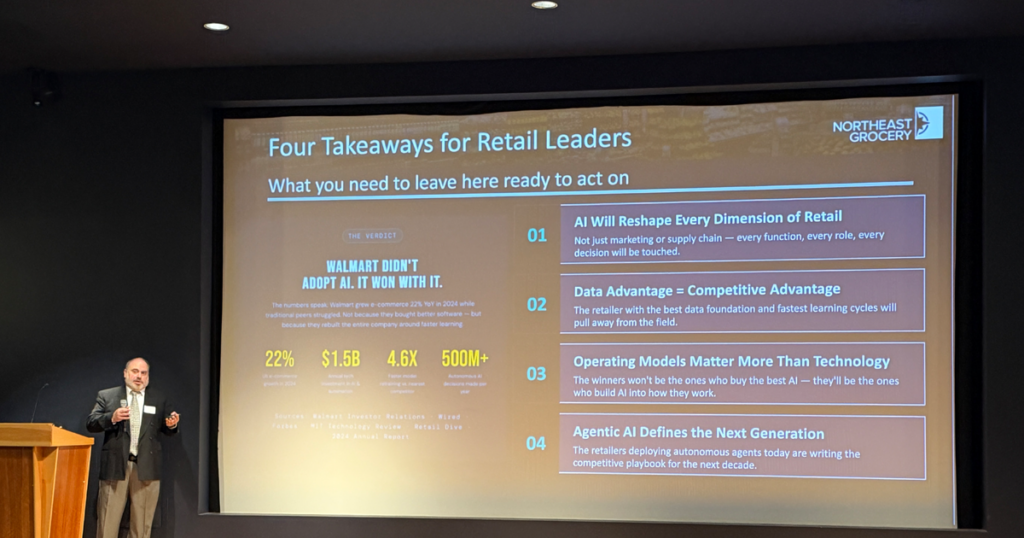
On March 27th, 2026, marketers, executives, and students came together at the University at Buffalo to talk about one big question facing our industry right now: How are people actually using AI?
What stood out wasn’t hype or panic, but real examples from people in vastly different roles using the same tool in very different ways. The takeaway was simple: AI doesn’t care who you are or what your title is. What matters is how you choose to use it.
AI is, without a doubt, changing the world as we know it — closing doors, but also opening new opportunities. There is a lot of excitement, fear, and most of all uncertainty.
So, how are marketers using this disruptive tech?
When it comes to the use of AI in marketing, think of it as a tool, an assistant, NOT a flawless shortcut. AI is agnostic. It does not care about or know who is giving the prompts, the status of that person, how long they have worked in their industry, or if they are a CEO, manager, analyst, or intern. For this reason, it is important to develop skills around AI, while also maintaining a strong foundational understanding or skillset based around your given industry.
The quality of your prompt determines the outcome quality. Can a high schooler develop the next big app that the world adopts from their garage for $20 a month? Yes! Can a CEO of a small company capture the majority market share of their industry by using AI more effectively because of their decades of knowledge, hard work, and experience in their field? Yes!
Real World Examples
One of the speakers at the conference was Terry Ameno, Director of Packing and Design at Buffalo Games. He spoke about how he uses AI to help create designs for the packaging of Buffalo Games’ products. Now, for a fraction of the cost and time he can create and alter designs from scratch or from actual photos that he already has. But, with his decades of experience, he has the eye to feed the AI quality prompts for more effective results. He no longer needs a professional photographer, which is unfortunate for the photographer. But remember, AI presents opportunities too. Maybe the loss of business from Terry isn’t so bad because the photographers can now save on the cost of a website by coding their own with an LLM!
Another speaker, Ron Ferri, President of Tops Markets, has deeply integrated AI into the Tops workforce. In the Western New York Region, Tops owns the highest market share of grocers. Part of their success derives from personalized marketing from AI for:
- Weekly flyers
- Merchandising and assortment
- Pricing and promotions
- Demand forecasting
- Task automation
- And much more
In fact, Tops has a ChatGPT Champions program designed to help employees exceed and excel individually and for the organization. Tops believes that “responsible AI is non-negotiable.”
Another presentation was delivered by students of UB’s School of Management program. They used LLMs to find gaps in a local coffee shop’s (Toasted) marketing plan, using AI for market research, planning, strategy creation, and an implementation roadmap. What’s even more impressive is that these young students discovered many pitfalls of blindly trusting AI without checking and quickly implemented guardrails and checks to further enhance their research. This is a critical precaution to take with this new technology.
Alex Monaco, Expert Associate Partner at Bain & Company, is an agency-side marketer who is carefully tracking the best uses of AI to prepare her teams for success. She has found success in a particularly important way in the developing AI era. Alex retains the human touch in her marketing strategy while reinforcing strong branding and credibility for the AI algorithms to pick up on. Internally, Alex encourages her team to use AI for productivity, research, recommendations, measurement, operations, and to workshop ideas. The final product is still the result of experts using their industry knowledge and experience to facilitate strong brand presence.
Retaining the Human Element
We all know that everyone is rushing into AI. However, there is an undeniable need for human connection that we all feel. During the conference panel session, one of the topics for the panelists was to provide advice for young people or those who were worried about AI replacing them. The panelists — Joe Frick, Senior Vice President of Growth at Goodway Group; John Coles, Vice President of Data Science and Analytics at ACV Auctions; Karen Stuhlmiller, Head of Data Management and the AI Center of Excellence at M&T Bank; and Scott Kessler, EVP and Chief Information Officer at Northeast Grocery — all shared a similar response. They encouraged everyone, especially young people, to:
- Continue to learn in-depth skills
- Learn interpersonal and communication skills effectively
- Become adept at public speaking
- Be capable and competent with AI
You know… the things that helped people excel before AI!
The main takeaway from the conference was the importance of developing workflows and operating systems around AI for entire teams, not just individual use. Ron Ferri summarized this feeling simply in his presentation by saying that because of fragmented datasets, talent shortages, and legacy tech debt, “Tech is 20% of the challenge. Operating model is 80% of the challenge.” Teams that effectively use this new technology will likely have a competitive edge over those who don’t. This raises the question: The tool of the century is here; how will you use it?
For more information, visit harmelin.com, or connect with us on LinkedIn or Facebook.