
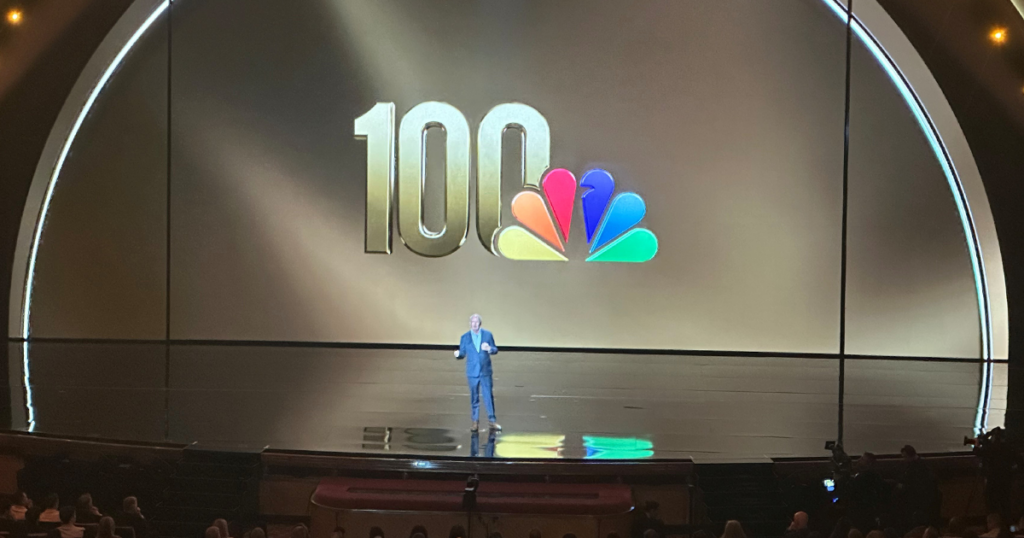
The 2026 Upfront presentations from the industry’s largest media companies, including Disney, NBCUniversal, Amazon, Netflix, Warner Bros. Discovery, FOX Corporation, and Paramount Global, made one thing clear: the television and streaming ecosystem has officially moved from experimentation to implementation.
This year’s presentations felt noticeably different from previous Upfront cycles. The industry is no longer selling the vision of streaming’s future; it is selling the operational reality of it. Conversations centered less around “what’s next” and more around scale, performance, automation, and proving measurable business outcomes.
Across nearly every stage, publishers reinforced the same message: streaming, AI-powered planning, audience-based buying, and commerce integrations are no longer emerging capabilities. They are now foundational components of modern media strategy.
Below is a breakdown of the themes that defined the 2026 Upfronts and what they signal for marketers moving forward.
Live Sports Remain the Centerpiece of Premium Video
If there was one clear constant across every Upfront presentation, it was the continued dominance of live sports.
In an increasingly fragmented media environment, live programming remains one of the few channels capable of delivering simultaneous mass attention at scale. For advertisers, that combination of reach, engagement, cultural relevance, and real-time viewership continues to justify premium investment. Publishers positioned sports not simply as content, but as one of the industry’s most valuable advertising environments.
NBCUniversal leaned heavily into the scale of the NBA, NFL, and Peacock’s growing live-event ecosystem. Disney reinforced ESPN’s role as the centerpiece of its broader streaming strategy, positioning sports as a critical driver of engagement and subscriber identity across ESPN, Hulu, and Disney+. Amazon continued showcasing the growth of Prime Video through Thursday Night Football, NBA coverage, and NASCAR, while FOX emphasized the continued power of tentpole events like the FIFA World Cup 2026, NFL, and college football.
Even Netflix, historically outside the live sports conversation, continued signaling its live-event ambitions following strong engagement around NFL Christmas Day programming and live specials, as well as the league’s newly announced, first-ever Thanksgiving Eve game, exclusively on Netflix, between the Green Bay Packers and Los Angeles Rams.
The broader takeaway was clear: as audience fragmentation accelerates, live sports continue to represent one of the last scaled, appointment-viewing environments capable of commanding attention in real time.
AI Has Become Infrastructure
One of the most notable shifts this year was how naturally AI was integrated into nearly every Upfront presentation. Unlike previous years, where AI was positioned as an emerging innovation, the 2026 presentations framed it as core infrastructure powering planning, optimization, targeting, creative, and measurement.
Publishers increasingly positioned AI as essential for:
- reducing waste
- managing frequency
- improving audience precision
- optimizing campaigns in real time
- simplifying cross-platform buying
Amazon continued emphasizing AI-driven planning and optimization through Complete TV, while NBCUniversal and Disney highlighted predictive audience tools, automation layers, and optimization capabilities built directly into their buying ecosystems.
The message across the industry was clear: AI is no longer a differentiator; it is now expected.
Unified Video Buying Is Becoming the Standard
The divide between linear and streaming continued to shrink as media companies leaned heavily into unified audience buying and cross-platform measurement. Throughout Upfront week, publishers consistently emphasized:
- deduplicated reach
- audience-based buying
- unified frequency management
- cross-screen attribution
- outcome-driven measurement
Disney continued expanding its audience graph and clean room capabilities, while NBCUniversal reinforced One Platform as a centralized planning and activation solution spanning both linear and Peacock inventory. Warner Bros. Discovery and Paramount similarly focused on simplified activation and cross-portfolio audience connectivity.
The broader industry narrative shifted away from “streaming vs. TV” and toward total video ecosystems optimized around audience outcomes.
Commerce & Interactive CTV Continue to Evolve
Another major theme throughout the 2026 Upfronts was the continued evolution of connected TV from a largely awareness-driven channel into a more interactive and performance-oriented environment.
Interactive overlays, pause ads, QR integrations, commerce-enabled creative, and second-screen experiences were heavily featured throughout the week. The shift reflects growing advertiser demand for measurable engagement and lower-funnel accountability within premium video environments.
Amazon remains uniquely positioned in this space due to its ability to directly connect advertising exposure with retail behavior and purchase data. Meanwhile, Disney and NBCUniversal showcased continued investments in interactive ad experiences designed to bridge storytelling and consumer action.
For years, CTV was primarily measured through awareness metrics. The industry is now clearly pushing toward making premium video environments more actionable, measurable, and commerce-enabled.
Premium Content & Cultural Moments Still Drive Value
Despite ongoing industry fragmentation, premium content remains the foundation of competitive differentiation.
Netflix leaned heavily into franchise programming and global cultural relevance, while Warner Bros. Discovery continued emphasizing prestige storytelling through HBO Max and premium IP. Disney emphasized marquee franchises, Hulu originals, and live sports, while FOX highlighted the enduring strength of live programming and legacy sports properties. NBCUniversal emphasized the enduring value of live sports, event programming, and cross-platform premium content within a scaled streaming ecosystem.
In a marketplace increasingly defined by audience fragmentation and infinite content options, premium programming has become one of the industry’s strongest tools for concentrating consumer attention. The companies that can consistently create cultural moments will continue commanding advertiser demand — and increasingly, premium pricing.
Network Highlights
Disney
Disney focused heavily on the continued expansion of ESPN’s streaming ecosystem, advanced audience identity capabilities, and the company’s ability to connect entertainment, sports, and streaming at scale across Hulu, Disney+, ABC, and ESPN.
Amazon
Amazon continued positioning Prime Video as a scaled, premium video platform powered by commerce data, AI-driven planning tools, and direct connections between advertising exposure and consumer purchase behavior.
Netflix
Netflix emphasized the rapid maturation of its advertising business through expanded measurement capabilities, live-event programming, premium contextual environments, and cultural exclusivity.
FOX
FOX leaned into the enduring value of live programming — particularly sports and news — while continuing to position Tubi as a major streaming growth engine within its broader portfolio. The company reinforced its strength in NFL, MLB, FIFA World Cup 2026, and college football, alongside investments in AI-driven advertising capabilities.
NBCUniversal
NBCUniversal centered its presentation around scale, live events, commerce integrations, and One Platform’s ability to unify planning, activation, and measurement across NBC and Peacock inventory.
Paramount
Paramount continued emphasizing cross-platform simplicity through Paramount Connect while reinforcing the strength of its combined streaming, broadcast, and live sports portfolio.
Warner Bros. Discovery
Warner Bros. Discovery focused on premium storytelling, audience-driven buying capabilities, and the strength of its entertainment and sports portfolio anchored by HBO Max and broader franchise IP.
Key Takeaways and Final Thoughts
The 2026 Upfronts confirmed that television advertising has entered a fully converged premium video era, where streaming, live programming, data, and automation now operate within a unified ecosystem. Across every presentation, several consistent themes emerged:
- Streaming is now part of the overall foundation of the premium video marketplace, not a complementary channel.
- Advertisers require greater accountability, unified measurement, flexible buying models, and measurable business outcomes across screens.
- Live sports, cultural moments, and premium content remain critical drivers of audience engagement and advertiser value.
- AI-powered planning, automation, and real-time optimization are becoming central to media buying and campaign performance.
- First-party data and audience-led strategies are increasingly essential for scalable targeting and personalization.
- Competitive advantages will shift toward marketers that can unify data, identity, creative, measurement, and activation across platforms.
- Success will depend on balancing long-term brand storytelling with performance-driven outcomes.
Ultimately, the companies and marketers best positioned for success will be those capable of connecting attention, automation, audience intelligence, and measurable outcomes within a single, converged video ecosystem.
For more information, visit harmelin.com, or connect with us on LinkedIn or Facebook.