
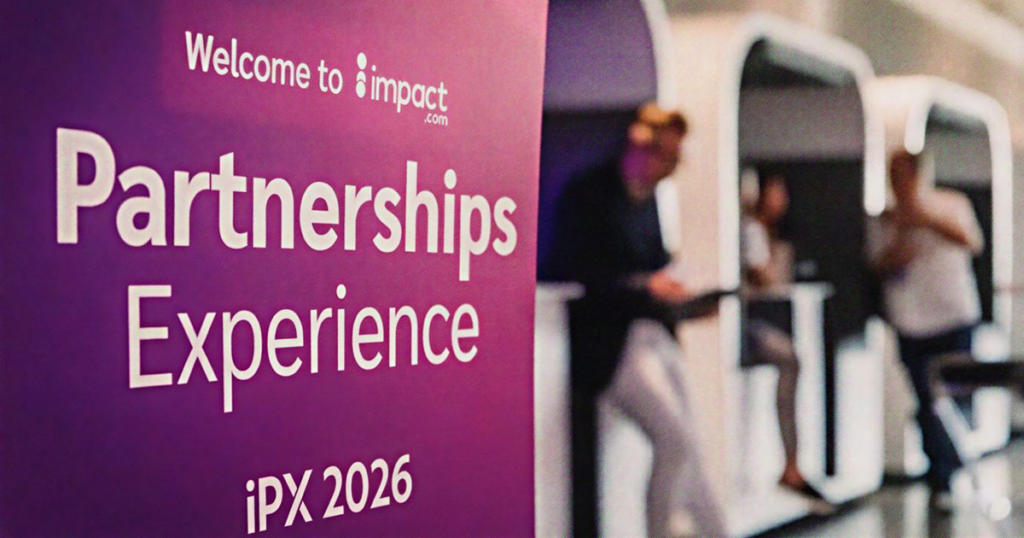
Impact.com’s annual Partnerships Experience brought together over 1,000 leaders in Austin, Texas, June 9-11, to dig into how AI, retail media, and the creator economy are reshaping the future of marketing and commerce. Here’s what you need to know.
The Big Idea: We’re Living in the “Answer Era”
The theme running through every session at iPX 2026 was a fundamental shift in how consumers find information and how brands need to show up. Search as we’ve known it is evolving. Users aren’t scrolling through pages of links anymore; they’re getting direct answers. The question for every brand has moved from “How do we rank?” to “How do we become the answer?”
Affiliate publishers, creators, reviewers, retailers, and content partners drive the critical credibility signals needed for these AI systems to include a brand in an answer.
The New KPI: From Clicks to Citations
One of the most discussed topics at iPX was how AI search is changing brand discovery. AEO (Answer Engine Optimization) has emerged as the new imperative: optimizing content not just for search engines, but for AI systems that generate answers. Visibility increasingly depends on whether AI systems view a brand’s content as credible, trustworthy, and consistent across the web.
A few key principles from the sessions:
- Convergence matters. LLMs build citations from consensus; the same answer needs to appear across multiple trusted sources to show up in results. The more consistently your brand shows up with quality content, the more likely you are to be cited in AI environments.
- Quality content can still get cited without formal AEO optimization, but having a strategy helps.
- Digital breadth is important, but quality still wins over quantity. More touchpoints equals more crawl surface, but weak content won’t cut it.
The key takeaway here is that if your brand is absent from trusted publisher content, creator conversations, and partnership ecosystems, you’re less likely to be cited by AI.
Retail Media Is the Third Pillar
Retail media was positioned at iPX as the third major pillar of the partnership economy alongside affiliate and creator marketing. Sessions highlighted how retailers like Walmart are expanding social commerce capabilities through creator partnerships, affiliate programs, shoppable content, and storefront experiences. Retail media is an integrated component of partnership-driven commerce.
The key shift: retailers are now publishers. Their data, inventory, and consumer relationships make them powerful media partners, and brands need to treat them as such within their partnership strategy.
Creator Marketing Grows Up
Creator marketing earned a dedicated track at iPX, and rightly so. The channel is no longer fighting for a seat at the table; brands and marketers have embraced its value.
Historically, creators were measured using mostly awareness metrics. However, as the creator economy evolves, brands are increasingly focused on how creator campaigns drive business results. Compensation models continue shifting toward hybrid structures, combining flat fees with affiliate commissions.
There’s a caveat though: performance doesn’t mean sacrificing authenticity. Creators emphasized that content performs best when it aligns with what they genuinely value and what resonates with their audience. The strongest indicators of success are often found in audience signals like positive comment sentiment, product-related questions, curiosity, and emotional reactions.
A persistent myth is that reach = results. Many brands just want to see the biggest influencer possible on the plan, but that’s not always the answer to the campaign objective. Speakers challenged the industry’s continued reliance on audience size and reiterated the importance of a focus on audience trust, content relevance, and distribution strategy.
The most successful brands are tapping creators at every funnel stage. Brands are asking not just “can this drive traffic?” but “how does this content work at every stage of the journey?” This is exactly why amplification of creator content is essential. Extending the life and impact of creator assets across the funnel is a key piece of a successful creator program.
Human Trust Remains the Ultimate Competitive Advantage
It’s been made clear that AI is not eliminating the need for creators. Instead, it’s changing how creators create.
Joshua van Aalst, founder of Just Josh Inc., used a compelling analogy. When MP3s and automatic beat-matching technology emerged, many believed DJs would become obsolete. Instead, DJs used the new technology to elevate the aspects of their craft that technology couldn’t replicate, leaning into creative mixing and performance.
The parallel to AI in creator marketing is direct: AI is changing what’s possible, but the human story, voice, and authenticity behind content is still what makes audiences lean in. The creators and brands that win will be those who use AI to do more of what makes them them, not the ones who outsource their identity to it.
Final Takeaway
iPX 2026 proved that partnership marketing is no longer a supporting channel; it’s becoming the connective tissue between AI discovery, creator influencer, retail media, affiliate marketing, and commerce.
As search evolves into answers and consumers increasingly rely on AI for product discovery, brands must think beyond traffic and clicks. It’s imperative that brands build trust signals everywhere AI looks:
- Trusted creators
- Publisher relationships
- Retail partnerships
- Affiliate ecosystems
- High-quality content
- Consistent brand validation across the web
The future of visibility won’t be won through algorithms alone; it will be earned through the network of partnerships that validate a brand across the digital landscape.
For more information, visit harmelin.com, or connect with us on LinkedIn or Facebook.