
This quarter’s healthcare newsletter highlights how AI is redefining the clinician-patient relationship, the impact of health and wellness influencers, and the structural challenges in fully implementing wearable data into patient care.

AI adoption is rapidly increasing among both clinicians and patients, transforming how healthcare information is accessed, interpreted, and discussed. While AI presents opportunities to improve health literacy and engagement, differences in tools, data quality, and transparency create new challenges for trust and clinical decision-making.
AI Redefining Clinician-Patient Relationship
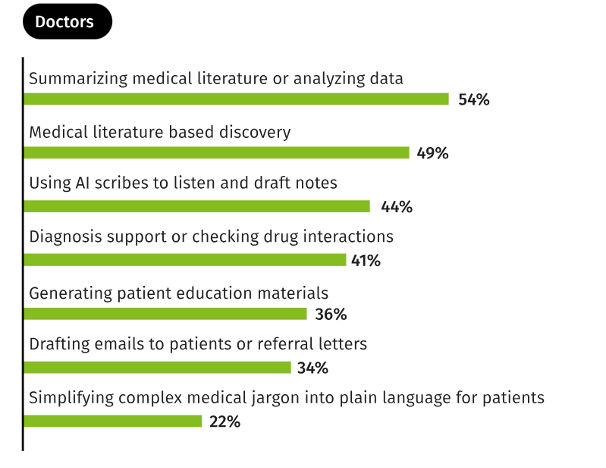
AI use among clinicians is increasing. The share of clinicians using AI multiple times a day has more than tripled for doctors (from 10% in 2025 to 38% in 2026) with the main use scenario being “summarizing medical literature or analyzing data” at 54%. It has also doubled for nurses (from 16% to 32%), indicating how AI is becoming embedded into everyday workflows.
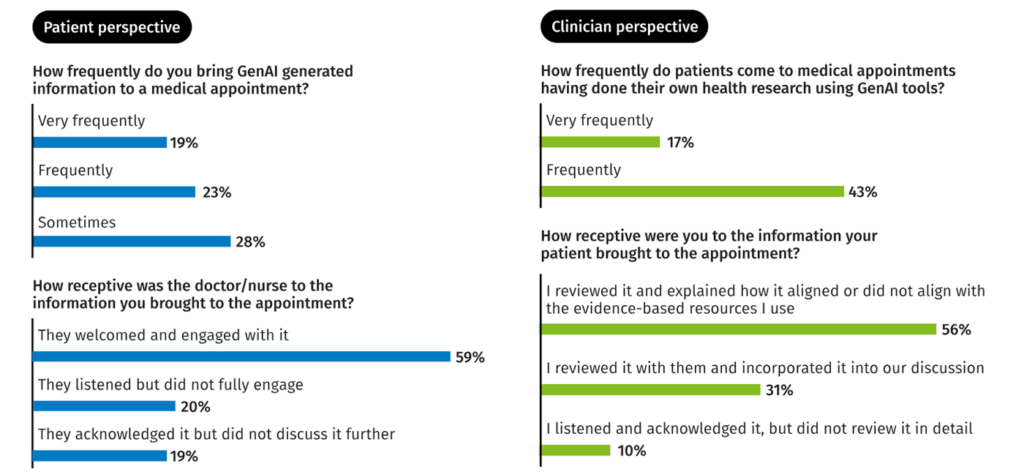
Patients are also using AI to prepare themselves for their appointments. With patients having limited time with their providers, they are making sure they make the most of that time by being a better advocate for themselves. 42% of patients frequently or very frequently brought AI-generated information to their appointments, with just under 60% saying their clinicians openly engaged with their data.
We’re seeing the introduction of AI redefine the relationship between clinician and patient. Both clinicians and patients see benefit in AI in helping improve communication, reduce tension, and increase trust within the relationship, with seventy percent of both groups believing that AI can improve patient health literacy and engagement. However, this could lead to either strengthening the relationship between clinicians and patients or increasing friction.
Although both parties are using AI, it’s likely the AI platforms they use have disparities between them, with clinicians using healthcare-specific tools designed around targeted clinical use cases, while patients are using more generalized platforms such as Google Gemini and ChatGPT for their health concerns. For example, a physician using a platform like OpenEvidence, which has agreements with reputable journals like JAMA, will receive a more thorough and sourced response, compared to a patient using ChatGPT that cannot access information beyond publicly accessible content on JAMA.
There are also additional concerns from both clinicians (72%) and patients (61%) that sponsored outputs could introduce bias into AI-generated responses. With these bias concerns and providers having healthcare-specific AI tools, as well as their knowledge set, the role of the clinician is now expanding. Clinicians need to interpret and validate outputs generated from tools that do not follow the same standards of transparency or oversight required within the health system, adding a layer of evaluation and contextualization that requires both time and training.
With this delicate balance of AI in the clinician-patient relationship, health systems and providers can use this as an opportunity to strengthen their relationship and build trust with patients. It doesn’t seem like independent AI use along the patient journey will be decreasing anytime soon, nor will it with providers. How healthcare systems and clinicians listen to, engage, and educate their patients on AI health use may lead to a healthier relationship between the clinician and patient.
Source: https://www.wolterskluwer.com/en/news/future-ready-healthcare-ai-adoption-patient-clinician-insights

Social media influencers are becoming a major source of health and wellness information, particularly among younger adults who often encounter content passively through platform algorithms. As influencer-driven health content gains reach and influence, healthcare organizations have an opportunity to establish trust and provide credible information where consumers are already engaging.
Health Voices Beyond Providers
Social media is a huge component of today’s media landscape, where users share, post, and consume content, often dictated by what the algorithm chooses. Outside of a user’s annual check-up with their primary care provider, they have access to what seems like never-ending health content to consume from people who top the health & wellness spaces. These content creators can share their advice in a more entertaining, engaging, and on-demand way than what their providers can offer.
A Pew Research report released in May 2026 found that half of U.S. adults under 50 say they get health and wellness information from social media influencers or podcasts, mainly spanning across Instagram, TikTok and YouTube. However, only 41% of health and wellness influencers that were analyzed say they have a background as a health care professional. Some influencers do not even provide any credentials in their bios even though they may be providing health advice. The algorithm is dictating the discovery of these influencers and their advice. 67% of health and wellness influencer consumers say they mostly just happen to come across it, with only a third of adults actively seeking information out. This could lead to misinformation, especially if a user is seeing this content more frequently than they see a healthcare professional.
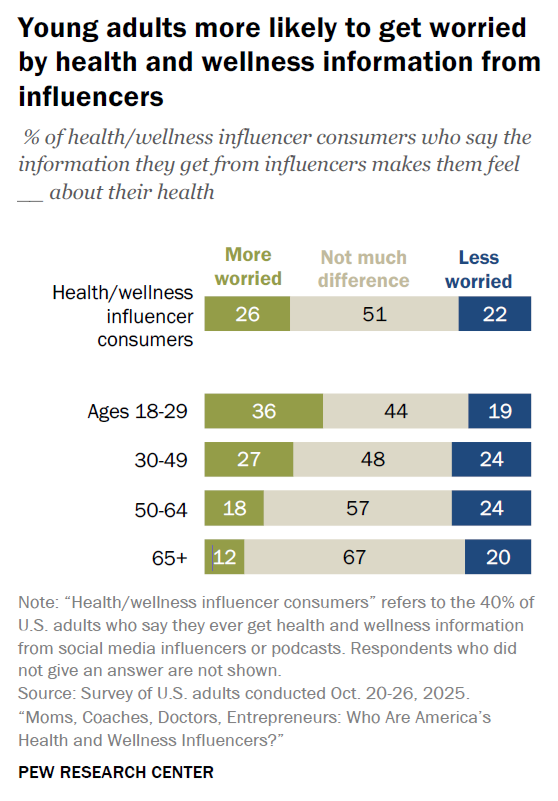
Of no surprise, those tuning in the most are young adults (18-29). They consume health and wellness influencers for the entertainment factor of their content. Despite this, influencers are still making an impact on young adults as they are more likely to get worried about their own health through the information they receive (36%), as compared to 26% of overall consumers.
Looking at the gender breakout of young adults, 57% of women 18 to 29 say they have gotten health and wellness information from influencers, 10% pts higher than the share of men.
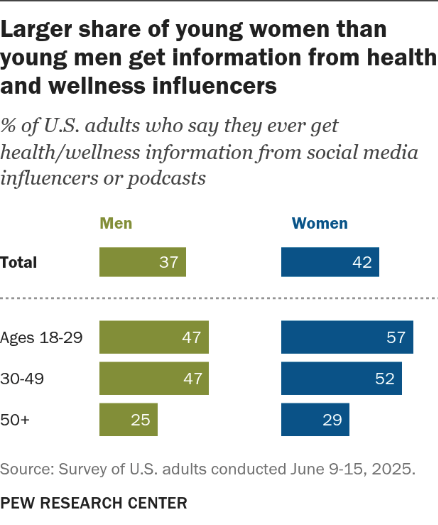
With social media being so accessible and especially popular with younger generations, reaching these users on Instagram, TikTok, and YouTube — where they are showing to be impacted by the health content they consume — would be a good way to address their concerns and provide trust as a health system in a landscape with so many loud and contradicting voices.
Sources:
- https://www.pewresearch.org/short-reads/2026/07/13/nearly-6-in-10-young-women-get-health-and-wellness-information-from-influencers/
- https://www.pewresearch.org/data-labs/2026/05/07/moms-coaches-doctors-entrepreneurs-who-are-americas-health-and-wellness-influencers/

More consumers are using wearable devices and sharing their health data with their healthcare providers. While physicians recognize the potential benefits, concerns about reliability and the lack of supporting clinical infrastructure are slowing broader adoption in patient care.
Wearable Data Integration Facing Clinical Hurdles
As wearable technology continues to advance, many consumers are seeing how they can better use the health data collected with their health care providers (HCPs). According to a recently released report by Rock Health, 46% of adults in 2025 reported owning a wearable device, with 35% of them using their devices to track physical activity, 26% to track sleep, and 21% to track their heart rate1. These devices provide consumers with stronger health autonomy.
Consumers are not just using this data for their own personal tracking; they are going to their HCPs and sharing this data for their expertise. 30% of owners have discussed their wearable data regularly with a HCP, while 29% have done so at least once, and 20% expressed desire to bring it up but haven’t done so yet1. Consumers are actively trying to take control of their health and be proactive with their clinicians to improve their health outcomes. However, there are some barriers with the current integration of data from these wearables into clinical practice.
The American Medical Association Center for Digital Health & AI and Medscape released a study in July 2026 diving into how physicians interact with consumer-grade wearable devices in clinical practice. Physicians see clinical advantage in using wearable data, so the motivation is there to help their patients with what they share.
The major constraints that hold back some physicians in the US are the liability concerns with the accuracy of the data and the lack of automation to assist clinical workflows2. The concerns outweigh the optimism in feasibility to discuss wearable data with their patients, with more physicians reporting it’s more practical to discuss the data and their limitations than reviewing and interpreting the data itself with them2. Physicians may still review patients’ wearable data to help address patients’ concerns but will set up expectations with their patients and use the wearable data scores as low-confidence adjuncts.
Although wearable device users are willing to share their data with their HCP’s and physicians see a clinical advantage in using it, there are still structural gaps across medical device innovators, health information technology innovators, and randomized controlled trials/peer-reviewed supported evidence, which are limiting immediate utility of wearable device data. Once these gaps are strategically addressed, we can hopefully see the implementation of technology to better address patient health outcomes.
Sources:
- https://rockhealth.com/insights/whats-your-score-insights-on-wearables-and-connected-devices-from-rock-healths-2025-consumer-adoption-survey/?_sp=8d3892e9-112a-4b8a-bc90-1ef063008d3e.1784747300889
- https://www.ama-assn.org/practice-management/digital-health/international-physician-survey-consumer-wearables
For more information, visit harmelin.com, or connect with us on LinkedIn or Facebook.