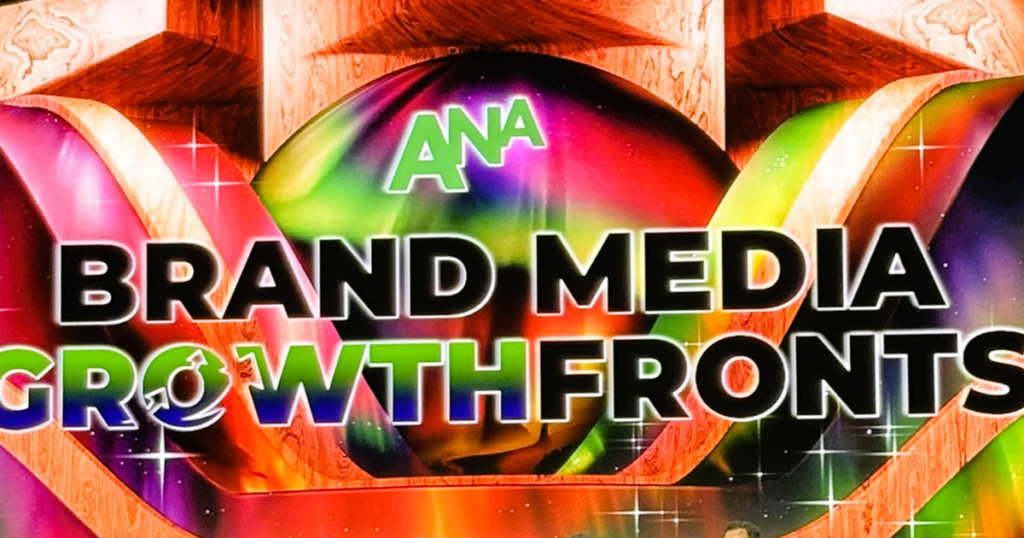
If the ANA Brand Media GrowthFronts 2026 made one thing clear, it’s that the industry is at a reset point. Growth is harder to find, audiences are harder to reach, and the old separations between media, creative, and culture no longer hold.
What brands are asking for now isn’t more tactics, it’s accountability — accountability for growth, relevance, and connection. And that creates a defining moment for agencies willing to evolve how they operate, plan, and lead.
I. The Big Shift: Accountability Across Media, Creative, and Culture
GrowthFronts reinforced a reality many agencies are already feeling: silos don’t survive in today’s marketplace. You can’t plan media in isolation from creative, or creative without cultural context, and still expect performance.
Brands are under economic pressure. Ad spend is flat or down across the board, with dollars shifting rather than increasing. Growth is showing up in local media, while network and national channels continue to decline. At the same time, programmatic and ad tech continue to grow, but often in ways that move brands further from the audiences they’re trying to connect with.
The implication for agencies is clear: media is a growth lever tied directly to creativity, trust, and culture. Agencies must operate as integrators, not executors.
II. Planning for Growth Segments with Precision
One of the strongest calls to action at GrowthFronts was to rethink how we define and prioritize audiences, especially growth audiences. Too often, brands default to surface-level targeting without truly understanding who those audiences are or what they need. GrowthFronts challenged that mindset by reframing relevance as value. Who are you talking to? What problem are you solving? What triggers action?
A simple but powerful example came from Disney Experiences’ Lisa Becket. Visits were down as most families are feeling the economic struggle and instead of chasing a new audience, Disney focused on real family needs by adding incentives: a kids’ discount over the summer and offering access to a water park on the day of arrival, to name a few. These weren’t massive innovations; they were deeply relevant ones.
The NFL’s Marissa Solis shared why the league’s Bad Bunny moment worked: it went beyond surface-level targeting. It wasn’t about reaching “Latino Gen Z” on paper, but about understanding what Bad Bunny represents: authenticity, cultural confidence, and the power of being seen without translation.
For agencies, the opportunity is to lead more precise segmentation conversations by helping clients strike intentionally at growth audiences while remaining genuinely relevant to every group they target. This also requires confronting a hard truth: most organizations still haven’t updated their change-management mindset to truly support inclusive marketing at scale.
III. The Role of AI — Without Losing the Plot
One of the most talked about concepts at GrowthFronts was a new definition of creative AI: “authentic imperfection.” The message was clear: you can’t AI your way to cultural authenticity. In today’s social feeds, overly polished brand content is easy to identify and easy to scroll past. Algorithms favor participation over perfection, and audiences reward honesty over control.
Three creative rules emerged:
- Make conversations, not ads. Participate in culture as it happens.
- Partner with creators — don’t cast them. Authentic partnerships are transformational, and audiences can tell the difference.
- The mistakes are the message. Raw, unscripted moments are what make content believable.
Some of the most valuable viral moments of recent years — the Stanley Cup car fire, #CleanTok and The Pink Stuff, Liquid Death turning hate comments into songs, Ryanair mocking itself using customer complaints — were powered by culture, not AI. None of them relied on generative tools to create the idea.
AI’s role is critical, but specific. The AI that actually works helps brands find what’s authentic, amplify it, and scale it. It belongs in discovery and analysis, identifying communities, finding credible creators, and accelerating asset creation once something real has been identified. What AI should never do is replace the human insight that creates cultural truth in the first place.
IV. Future-Proofing Client Media Strategies
GrowthFronts also highlighted the need to rethink what “scale” really means. Scale isn’t just reach, it’s where culture converts.
Speakers emphasized the importance of strategic multipliers: local media, passion points, creators, sports, wellness, and community-driven ecosystems. These environments deliver meaning, not just impressions, but they require different buying models and longer-term commitment.
For agencies, future-proofing client strategies means:
- Rebalancing toward direct buys and trusted partners
- Holding programmatic ecosystems accountable while supporting those doing it right
- Asking better questions about brand safety and adjacency
- Spending time building real relationships with media and creator partners
Convincing clients this is more than a lever to pull requires proof — data, case studies, and evidence that inclusion, authenticity, and cultural relevance drive growth when treated as investments, not experiments.
V. Final Thought: Why This Is an Agency Moment
Day one made it clear: authenticity is the theme. Day two made the business case undeniable: inclusive marketing may be the single biggest source of growth our industry has for the next several decades.
Across sports marketing — particularly women’s sports — health and fitness, and emerging cultural spaces, the message was consistent: don’t jump on trends without understanding needs. Credibility matters. Creators matter. Imperfection builds trust.
GrowthFronts 2026 wasn’t a call to do more, it was a call to do things differently — to plan smarter, connect deeper, and lead clients through complexity with confidence. For agencies willing to adapt, this isn’t a challenge; it’s an opportunity to move from intent to impact, and from execution to true growth partnership.
For more information, visit harmelin.com, or connect with us on LinkedIn or Facebook.