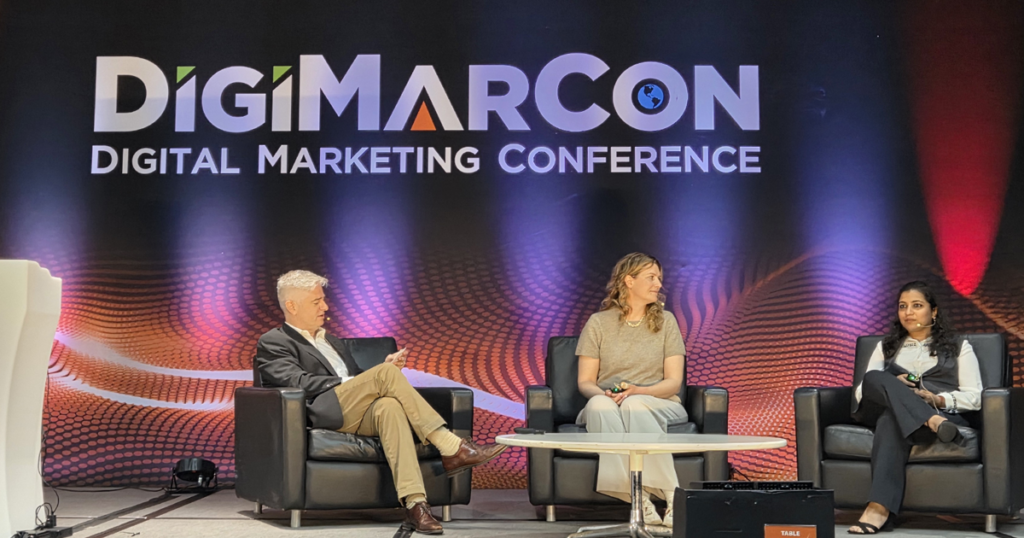
The DigiMarCon Midwest 2026 event in Chicago brought together some of the brightest minds in digital marketing to explore how AI is reshaping the industry without replacing its fundamentals. Across a full day of sessions, speakers shared practical frameworks, candid realities, and forward-looking strategies that highlighted one recurring theme: AI is not replacing marketers; it is reshaping how we work.
Here’s a recap of the biggest insights and themes from the conference.
Technical SEO Still Matters, Even in the Age of AI
Dave Rohrer, Principal at NorthSide Metrics, set the tone for the day by challenging a common assumption that AI tools are diminishing the importance of technical SEO. His key message was clear: AI depends on search — especially Google — more than we think. Tools like ChatGPT and Claude do not operate in isolation; they rely heavily on existing search data and structured content across the web.
One striking insight came from a study he cited, which found that you would need to ask Claude the same question approximately 1,429 times before receiving two responses that contained the same list of brands in the same order, highlighting widespread inconsistency across AI-generated answers. This variability reinforces the need for solid technical SEO foundations, including clean site structure, crawlability, performance, and schema, to ensure that content is discoverable and reliably interpreted.
He also noted that personalization is becoming essential, meaning generic optimization is no longer sufficient, and that understanding user personas leads to better rankings and engagement. Ultimately, technical SEO remains the backbone of discoverability.
SEO Meets Social: The Rise of AEO and Multi-Channel Strategy
Rebecca Lehmann, Content Creator and Organic Growth Marketing Leader, explored the convergence of SEO, AEO (Answer Engine Optimization), and social media. She emphasized that search behavior is no longer limited to traditional search engines. Platforms such as Reddit, YouTube, LinkedIn, Facebook, and Instagram are now among the top citation sources influencing visibility and authority.
Her message was a strong call to action: “SEO can’t live in a silo anymore.” She made it clear that social platforms now play a critical role in visibility and authority signals, and that SEO strategies must align with cross-functional teams, especially social media teams. She also stressed that content must be valuable, engaging, and user-focused, and warned that over-reliance on AI-generated content is risky, as authenticity continues to win.
Lehmann reinforced that success in SEO and AEO requires human-centered storytelling combined with thoughtful multi-channel distribution.
AI as a Co-Worker, Not Just a Tool
In the panel session, moderator Scott Fenstermaker, Nicole Kuebler, and Shagun Agarwal brought together a range of perspectives on how AI is transforming marketing roles. A major shift discussed was the move from traditional marketing metrics to Marketing Efficiency Ratio (MER), which provides a more holistic measure of performance.
The panel emphasized that AI should be treated as a collaborative partner rather than a replacement, and that authentic, human-generated content is becoming more valuable in this new landscape. The panel addressed the concern of job displacement and concluded that adaptation, creativity, and human judgment will remain irreplaceable.
They also discussed how Gen Z influence is reshaping marketing strategies and noted that large influencers are gradually losing ground to niche communities and micro-influencers. Measuring success now requires a deeper focus on engagement and conversions rather than surface-level metrics.
Building Smarter Workflows with AI
Andy Crestodina, Co-founder/CMO at Orbit Media Studios, closed the day with a hands-on look at how to use AI tools effectively. Rather than focusing on one-off prompts, he encouraged marketers to build scalable systems using reusable prompt frameworks, custom GPTs, and workflow automation.
He shared examples such as persona generators for marketing campaigns, page auditors that analyze UX and SEO, and wireframe generators driven by AI insights. He underscored that AI is most powerful when used as part of a system rather than in isolated tasks and noted that lightweight formats like markdown can improve efficiency.
He also highlighted the importance of continuous testing and refinement and encouraged marketers to evolve into AI workflow managers. A strong emphasis was placed on collaboration and sharing tools to accelerate organizational learning.
Final Thoughts: The Future Is Hybrid
Across sessions, a clear narrative emerged: AI is not replacing marketing but redefining it. Success in this new era depends on strong technical foundations, as SEO still matters, as well as multi-channel strategies that integrate search, social, and AI. It also requires structured processes and training, along with human creativity and authenticity, and the ability to adapt to constant change.
The marketers who will thrive are those who can bridge technology with human insight, using AI as a co-worker to scale their expertise rather than replace it. If there is one takeaway from DigiMarCon Midwest, it is this: the future belongs to marketers who can combine data, systems, and storytelling into one cohesive strategy.
For more information, visit harmelin.com, or connect with us on LinkedIn or Facebook.