
There is no doubt we are in the middle of a lifestyle shift as more adults are choosing to take a GLP-1 drug. With the release of GLP-1s in pill form coming soon, there will be many more consumers opting to take part. The implications are far-ranging and having both positive and negative effects on gyms and fitness centers, apparel companies, alcohol and beer distributors, and, most notably, the food service and grocery industries.
With adults who take GLP-1 drugs consuming approximately 16% – 39% less calories than during non-GLP-1 use4, it’s easy to understand why QSR brands may be panicking about potential revenue loss created by the release of these wonder drugs. However, it’s important to understand that the impact of GLP-1 use on restaurants — especially QSRs — is more nuanced than the “restaurants will lose customers” narrative, and there are many ways, both from an operations and a marketing perspective, that QSR brands can thrive within the current GLP-1 landscape. In this paper we’ll assess the implications and outline steps Harmelin Media recommends that QSR operators take to succeed in the face of increasing GLP-1 usage.
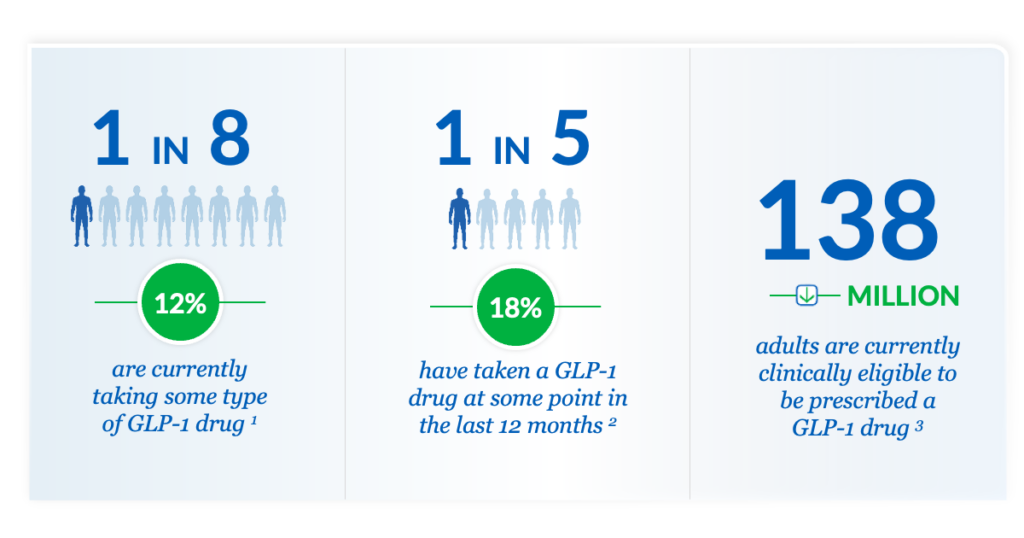
The statistics are impressive:
Why Are GLP-1 Drugs a Threat to QSRs?
At the most basic level, GLP-1 drugs quiet the body’s hunger signals and reduce the “food noise” people often wrestle with on a regular basis. “Food noise” refers to intrusive thoughts people have about food, cravings, and eating that occur whether someone is physically hungry or not. It is a constant inner monologue that some people can easily suppress, while it entices others to give in to their cravings, regardless of physical hunger. It is constant, consistent, and can make it difficult to focus on daily tasks and maintain healthy habits5.
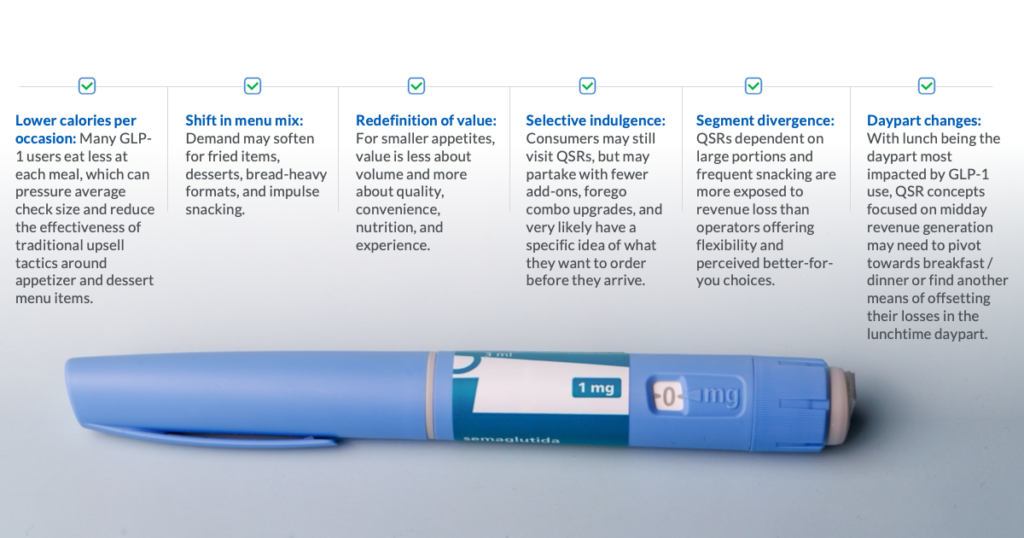
When using GLP-1 drugs, people experience a physiological change that results in eating smaller meals, consuming fewer calories, and eating less often, while also altering their mental reward system which replaces food and snacking with some other treat. The impact is real, with transaction-based research showing that households using GLP-1 therapy reduced spending at fast-food, coffee, and other limited-service outlets by roughly 8% in the first six months after starting their prescription6.
Implications of GLP-1 Use for QSRs
Effective and successful use of GLP-1 drugs is best achieved by combining the drug use with a significant lifestyle change. People who use GLP-1s require high-protein meals, smaller and healthier snacks (think nuts, fruit, yogurt), nutrient-dense foods, and eat smaller meals at one sitting. It also potentially changes what food means to the consumer. In the face of these habitual changes, what does this mean for the QSR industry as a whole?
Harmelin’s POV on Next Steps for QSR Operators
As with most things, the answer is never straightforward and is never just one thing. The best approach is layered and nuanced, designed to tackle the problem from multiple angles. However, there are two primary elements that need to be addressed: marketing and operations. If we are truly seeing a structural lifestyle change in consumers due to GLP-1s, then it requires rethinking how QSRs market themselves and the way they operate their locations. Marketing plays a key role in how consumers perceive a QSR brand as being either GLP-1-friendly or a brand where they can reward themselves for their hard work and provide themselves with a hard-earned treat or indulgence, but marketing needs help from store operations to blunt the onslaught of GLP-1 usage.
Marketing Recommendations
From a marketing and media perspective, it’s important to understand that although GLP-1 usage is on the rise and represents a large part of the overall adult population, it is still only one segment of the US adult population. In no way should any QSR overcorrect and pivot fully into the GLP-1 craze — they should simply realize that GLP-1 users are a new segment of the population that must be understood and to whom marketing dollars should be allocated. To that end, Harmelin recommends QSR operators consider the following:
- Refine your messaging: Position your brand around balance, quality, and satisfaction, rather than abundance. Remember, value takes on a different meaning to those fully adopting the GLP-1 lifestyle.
- Track behavioral signals closely: Monitor attachment rates, combo mix, snack incidence, beverage mix, and protein-led item performance to understand how the shift is affecting your customer base. This is about education and the effects GLP-1 use is having on your brand.
- Don’t mention GLP-1s: Although 59% of diners would be likely to order smaller, protein-based menu items, over 37% say they are absolutely not interested in a menu labeled as GLP-1 — meaning there is interest in the offering but not the identity7.
- Segment your customer base: Know your customers and personalize your message to them. The GLP-1 user has a never-before-seen unique profile. They might be a previous customer, but they are now part of a different segment with a different behavioral and psychological profile, and they have different triggers than they did previously.
- Follow lifestyle changes: A change in lifestyle is typically accompanied by a change in media consumption. A new lifestyle involves new habits, and new habits precede different behaviors. Those different behaviors mean GLP-1 users are now consuming different content — new videos; new websites; different books, magazines, and articles. Successful media placement is about meeting the consumer where they are, and being in front of GLP-1 users is no different.
From an operations standpoint, QSR brands can pull multiple levers to retain current GLP-1 customers or draw in new GLP-1 consumers:
- Rebuild value architecture: Introduce smaller, premium-feeling meal formats and right-sized bundles to protect margins.
- Lean into protein and functionality: Expand items that deliver protein, fiber, hydration, or other health-adjacent benefits without sacrificing convenience.
- Use menu design to reduce friction: Highlight lighter options, customization, and nutrient-dense choices.
- Protect a core indulgence, but moderate it: Keep signature craveable items, but offer mini formats, add-on flexibility, and portion choice.
Operational changes are not easily or quickly implemented, but GLP-1 usage is not going away, and only shows signs of growing. Even though consumers may change what they’re eating, how they’re eating, and when they’re eating, the fact remains consumers still dine out8 — whether for convenience, necessity, or indulgence — making operational alterations a necessity for QSRs to remain competitive and generate positive revenue flow.
Harmelin’s Bottom Line
GLP-1 medications are not eliminating restaurant demand, but they are changing the economics of food away from home. For quick-service restaurants, the primary risk isn’t a decrease in foot traffic; it’s in not identifying the shift in what consumers value, and how and what they purchase. As more consumers eat less per occasion, avoid indulgent items, and prioritize protein, QSR operators need to move beyond a model built primarily on calorie density, upsizing, and impulse add-ons.
There is also the very real possibility there will be continual churn among GLP-1 users, as people cycle on and off the drugs throughout their lifetime. Most people — almost 75% — discontinue GLP-1 use after 12 months9, and we know that lifestyle changes are hard to adopt and very often do not stick. However, from a QSR standpoint, the more important numbers might be that 18% stop use after just three months, and 31% discontinue use after six months10. What is still unknown is how many people who cycle off GLP-1 drugs ultimately end up returning to their pre-GLP-1 lifestyle and eating habits. History would seem to indicate there will be plenty of people “falling off the GLP-1 lifestyle wagon.”
From a marketing perspective, audience segmentation, message personalization, and message frequency are keys to thriving during the GLP-1 era of dining out. With millions of people constantly churning in and out of the GLP-1 lifestyle, maintaining a consistent presence is key. As important as this might be, proper messaging is more important. It is very clear that GLP-1 users do not want to be labeled as such when it comes to their menu selections, but they need to know those options exist and are embraced by the restaurant. This is where understanding your audience is paramount, and where matching your message to the correct audience is key.
Ultimately — as is usually the case in QSR marketing — the winners are likely to be brands that can create a nuanced approach, balancing the correct menu offerings with the proper messaging and marketing plan.

References
1 KFF, November 2025
2 KFF, November 2025
3 Beth Israel Deaconess Medical Center, November 2024
4 Baylor Scott & White Health, May 2026
5 Tufts Medicine, August 2025
6Cornell Chronicle, September 2025
7 Curion, March 2026
8 WSJ, “GLP-1 Users Are Taking a Bite Out of the Restaurant Business”, May 13, 2026
9 Northwestern Now, November 2024
10 Northwestern Now, November 2024
For more information, visit harmelin.com, or connect with us on LinkedIn or Facebook.