
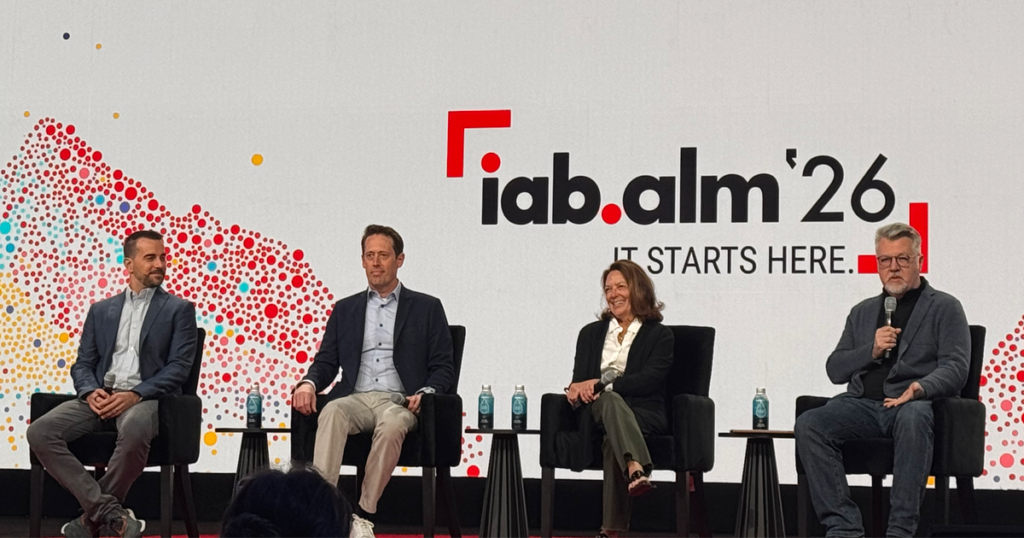
After listening to industry leaders, joining breakout sessions, and talking with some of the smartest minds at the 2026 Interactive Advertising Bureau Annual Leadership Meeting (IAB ALM), there were a few common threads that kept emerging about how fundamentally our industry is changing. In short, the advertising industry has already crossed a threshold. What was once an incremental evolution is now a structural reset. This is no longer about adapting processes; it’s about rethinking roles, operating models, and responsibilities in a world reshaped by artificial intelligence, fragmented attention, and declining trust.
From the Human Web to the Agentic Web
The internet is rapidly bifurcating into two realities — one designed for humans and another designed for machines acting on behalf of humans. The agentic web is accelerating fast and will soon dominate how decisions are made, content is discovered, and commerce occurs. For agencies and marketers, this changes the game entirely. We are moving from influencing people directly to influencing people and the systems that act for them. That means traditional optimization cycles, planning timelines, and even definitions of audiences are becoming obsolete.
This moment demands a willingness to experiment in imperfect conditions. The environment will be messy, uncertain, and uncomfortable. Waiting for clarity is not a strategy. Progress now requires learning while moving, building while flying, and optimizing in real time rather than relying on long-range certainty.
Experimentation with Discipline, Not Chaos
The industry is clearly in an experimentation phase, but experimentation alone is not enough. The winners will be those who balance speed with focus. Solutions must be usable, scalable, and clearly tied to outcomes. Innovation theater will not survive budget scrutiny. This means moving beyond pilots that never graduate. It means insisting that new tools and AI-enabled workflows solve real business problems rather than simply showcasing novelty.
Client-side marketers cannot remain observers of this transformation. They need to be embedded alongside agencies, technology providers, and data partners in shaping how systems are built and deployed. This new reality is moving too fast and is too complex for one entity to solve. It will take deeper collaboration and trust among partners.
AI as a Supercycle, Not a Trend
Artificial intelligence is not another platform shift. It is a supercycle, faster and more profound than the internet itself. Yet many organizations are still approaching it linearly, running controlled pilots while the underlying technology compounds exponentially.
This mismatch creates risks, not only competitive risk, but organizational risk. As AI begins to handle tasks once owned by entry-level talent, companies face a looming knowledge gap. Investing in AI tools without investing in AI literacy and foundational skills is a recipe for long-term fragility. The organizations that thrive will be those that treat learning as continuous: Learn. Unlearn. Relearn.
They will also create psychological safety for leaders and teams to test ideas without fear of failure. Without that safety, innovation stalls.
Authenticity, Inclusion, and the End of Over-Curation
As technology accelerates, human expectations shift in the opposite direction. Audiences are increasingly skeptical of perfection. Over-curated brands struggle to connect, while those willing to show imperfection, vulnerability, and humanity will build deeper loyalty.
Inclusion is part of this shift. It is not just moral imperative; it’s a growth strategy. Brands that invite more people in, rather than optimizing for narrow definitions of desirability, can unlock new demand and long-term relevance.
This requires rethinking channel frameworks, target definitions, and performance metrics. Authenticity does not always look efficient in the short term, but it compounds trust over time.
Trust as the New Scarcity
If attention defined the last era of media, trust defines the next. Trust is now tied with price as a top decision driver for consumers and it is eroding across institutions, platforms, and media channels.
This has massive implications. If consumers do not trust the medium, they will not trust the message. And trust cannot be manufactured through reach or AI alone. It is built through consistency, transparency, and real-world relevance.
This is why communities will matter more than audiences. Focusing on communities requires participation, shared values, and accountability. Audiences define exposure. The future belongs to brands that matter, not brands that simply market.
The Shifting Role of Channels and Measurement
Channel definitions are collapsing. Every channel is now digital. Every channel is mobile. Every channel is measurable, at least in theory. Yet legacy structures and silos continue to distort how media is planned, bought, and evaluated.
AI has the potential to realign channels and measurement, but only if data foundations are sound. Poor taxonomy in equals poor intelligence out. Human oversight remains essential, especially as automation scales. At the same time, some formats are proving more resilient than expected. Audio continues to deliver an outsized impact on recall, trust, and brand lift. Video is no longer merely an upper-funnel tool; it performs across the entire customer journey when messaging is sequenced correctly.
Return on ad spend (ROAS) alone is increasingly insufficient as a north star. It is precise but narrow. Long-term brand impact, incremental reach, and trust-building effects must be part of the measurement equation.
Compliance, Guardrails, and the Cost of Getting It Wrong
As AI becomes embedded across marketing workflows, compliance can no longer live solely within the marketing department. It must be enterprise-wide. Education, governance, and coordination across teams are now table stakes.
Regulatory complexity is real, particularly as laws vary across states, but closer collaboration between businesses and regulators is not just defensive; it’s an opportunity to help shape frameworks that protect consumers without stifling innovation.
Above All Else, Serve the Customer
Across all this complexity, one principle remains constant. When advertising is done well, it is a service to the consumer. Technology does not change that responsibility; it amplifies it.
AI will make intelligence cheaper, faster, and more abundant. It will expand access and reduce scarcity across many sectors. But differentiation will still come from judgment, empathy, creativity, and trust. For marketing, the mandate is clear: build systems that scale intelligence but lead with humanity. Experiment boldly but anchor decisions in service. Race in the rain but never lose sight of why you are running in the first place.
The future is arriving quickly. Whether it becomes chaotic or transformative depends on how intentionally we choose to build it.
For more information, visit harmelin.com, or connect with us on LinkedIn or Facebook.