
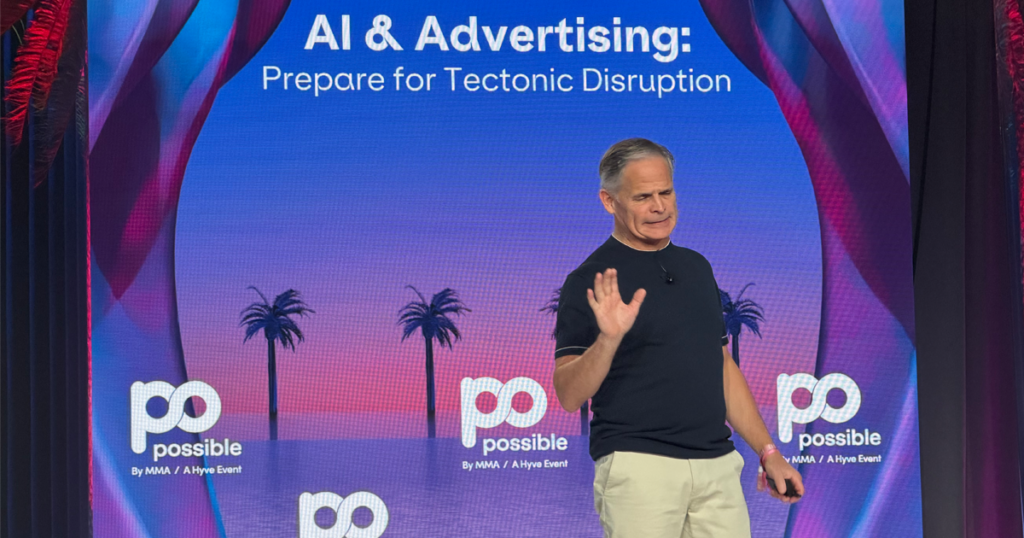
POSSIBLE 2026 in Miami Beach brought together more than 10,000 marketers, technologists, and industry leaders, all focused on answering a critical question: what happens next? While the conference is known for bold predictions, this year felt different. There was a clear shift from experimentation to urgency, and from curiosity to real consequences for how the industry operates.
While there were many amazing panels and conversations, one keynote in particular stood out as the clearest articulation of where things are headed. Terry Kawaja, CEO and Founder of LUMA Partners, reframed the conversation with a simple but powerful message: AI is not incremental; it’s tectonic. That distinction matters. We’ve seen waves of innovation before, from mobile to social to programmatic, and more recently Web3 and VR. Each brought progress, but none fundamentally reshaped the foundation of advertising in the way AI is already showing.
What makes AI different comes down to three defining characteristics.
- Breadth: AI has the ability to touch every role, every workflow, and every layer of the marketing ecosystem.
- Depth: It can ingest massive, fragmented datasets and turn them into meaningful, actionable signals in ways that were not previously possible.
- Severity: This is where the real disruption lies. AI has the potential to restructure the economics of the industry and shift where value is created and who ultimately captures it.
Kawaja also laid out a hierarchy of where AI is showing up today and where it’s heading. At the base level are operational improvements, things like workflow automation, measurement, and attribution. This is where most organizations are currently focused, and, while important, it’s quickly becoming table stakes. The next level is creative and communications, where AI is beginning to test, learn, and optimize messaging in real time, driving meaningful gains in effectiveness.
Beyond that is where things get more transformative. AI is changing how consumers navigate the internet, moving us from keyword-based search to conversational, context-rich interactions. This shift introduces a more powerful form of consumer intent. Instead of short, transactional queries used in search engines, users of the various LLMs are providing layered context, preferences, needs, and deep personal information. That creates a much richer signal, and one that could significantly reshape how marketers think about targeting, engagement, and conversion.
The implications of all of this are significant across the ecosystem. For platforms and large players, scale and existing advertising infrastructure still matter, and they are well positioned to capitalize on these shifts. At the same time, AI has the potential to democratize certain capabilities, allowing smaller, more specialized players to compete more effectively based on outcomes rather than just reach.
For agencies, the message is clear: the value proposition has to evolve. Process, execution, and access to tools are no longer enough to differentiate. The focus must shift toward measurable business outcomes and real impact, or risk becoming increasingly commoditized. This aligns with a broader theme that came up repeatedly throughout the conference: marketing is being held more accountable to growth, and that conversation is increasingly happening with the CFO, not just the CMO.
Publishers face a different, but equally complex challenge. High-value, niche publishers may find opportunities to monetize their content within AI-driven environments, but long-tail and general news organizations are under growing pressure to rethink their business models. There was a consistent undercurrent of concern about what this means for journalism and the broader information ecosystem, especially if sustainable models are not established.
Another area that generated a lot of discussion was the role of agents and autonomy. While there is a great deal of excitement around fully autonomous systems managing media and decisioning, the reality is that we are still in the early stages. The near-term opportunity lies in using AI to improve decision-making, rendering faster, more informed, and more effective choices. Trust will ultimately determine how quickly autonomy evolves, and that trust will need to be built through transparent, human-in-the-loop systems.
For me, if there was one takeaway that cut through all the noise, it was that sitting on the sidelines is not an option. The directive is clear: learn, test, build, or acquire the capabilities needed to compete in this new environment. AI is not something that can simply be layered onto existing processes. It requires a fundamental rethinking of how marketing operates.
POSSIBLE 2026 made that reality hard to ignore. AI is accelerating industry change, and we have now entered a phase where marketing value is being reallocated quickly, and not always evenly. The companies that are providing the most value and win will be the ones that quickly leverage AI to align marketing more closely with outcomes, integrate more deeply with finance, and treat growth as a shared responsibility across the organization as partners. Everyone else risks reacting to a game that has already been redefined.
For more information, visit harmelin.com, or connect with us on LinkedIn or Facebook.