Let’s talk about something the media industry would rather keep quiet.
Two practices are quietly reshaping how media gets bought in America — and neither is good for advertisers. The first is principal-based buying. The second is the pocketing of vendor rebates. Both have been around in various forms for years. Both are growing. And both represent a fundamental conflict of interest that every brand marketer deserves to understand.
We’ve Been Here Before
In 2016, the Association of National Advertisers commissioned an independent investigation by K2 Intelligence into media transparency practices. What they found was striking: non-transparent business practices, including undisclosed cash rebates paid by media companies to agencies, were pervasive in the media buying ecosystem. Not occasional. Not isolated. Pervasive.
Senior executives at big agencies and holding companies were not merely aware of these practices — they mandated them. Rebates flowed to agencies as cash, free inventory credits, and sham “service agreements” designed to obscure what were, in effect, kickbacks. Of the 41 sources who confirmed rebate activity, 34 said those rebates were never disclosed to advertisers and never passed back.
As an agency focused on transparency, the K2 report was fantastic for our business, firming up existing relationships and earning us new clients. But it left a dark mark on the media industry. The press called it “RebateGate.” There was outrage, updated contract templates from the ANA, and pledges of reform. Then, gradually, it faded from the headlines.
The Problem Didn’t Go Away… It Got Bigger
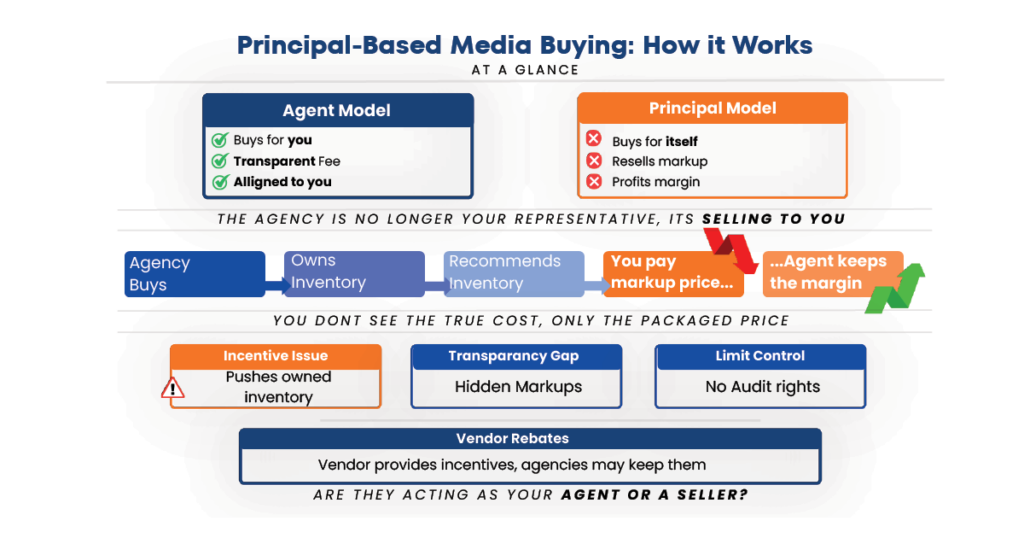
Fast-forward to today, and principal-based buying is not just back — it’s booming. Here’s how it works: rather than acting as an agent buying media on your behalf, the agency (or its holding company) purchases media inventory in bulk for its own account, then resells it to you at a markup. The agency is no longer your representative. It’s your vendor.
The markup can range from 10% to 90%, depending on the arrangement. You often have no right to audit it. In many cases, you may not even know it’s happening — a 2024 ANA survey found that nearly half of marketers weren’t fully familiar with the practice, and some had signed contracts permitting principal buying without realizing it.
The holding companies pushing this model hardest are now saying the quiet part out loud: it’s about profit margins. GroupM’s principal media revenue recently surpassed $1 billion annually. Publicis and Omnicom have each built principal trading businesses worth billions in revenue. Non-product-related income at WPP was forecast to grow 15% in 2024, even as the company’s overall revenue declined. This is happening in an environment where 90% of marketers cite uncertainty over whether media recommended is in their best interest, according to a 2026 ANA survey.
The conflict of interest here is not subtle. When your agency owns the inventory it’s recommending to you, its financial interest is to move that inventory — not necessarily to find you the best placement at the best price. The inventory that delivers the highest return for the agency may not deliver the best outcome for you. Those are not the same thing, and pretending otherwise is dishonest.
Vendor rebates introduce yet another layer of conflict. When media companies offer agencies cash, inventory, or other incentives for directing client spending to them, agencies gain a financial motive to prioritize those vendors—regardless of whether it’s best for you. Once again, your agency’s interests and your own are no longer aligned.
Why This Should Matter to You
The question worth asking your agency is a simple one: Are you acting as my agent, or as a principal? And if the answer involves any version of “both”… be skeptical.
An agency earning undisclosed rebates from a media vendor cannot objectively evaluate whether that vendor deserves your money. An agency reselling inventory it owns at an undisclosed markup cannot objectively advise you on whether to buy that inventory. These aren’t hypothetical ethical concerns. They are direct, structural conflicts of interest baked into the business model.
There are legitimate arguments that principal buying, done transparently and with full disclosure, can occasionally benefit an advertiser through lower CPMs or guaranteed outcomes. We don’t dismiss that entirely. But “done transparently” is doing a lot of work in that sentence — and transparency is precisely what these arrangements tend to lack. Consider an out-of-category example: your financial advisor quietly owns shares in every fund they’re recommending to you, but assures you it’s fine because they disclosed it somewhere in the contract you signed. How quickly would you find a new financial advisor? The media business deserves the same standard.
What the Industry Should Expect — And Advertisers Should Demand
Transparency in media buying isn’t a premium feature. It’s a baseline obligation.
Your agency should earn revenue from exactly one source: the transparent fees you agree to pay them. Any benefit received from a media vendor — cash, inventory, services, or anything else of value — should be fully passed back to clients, not the agency’s bottom line. Media should be bought on your behalf, as your agent, with your interests as the only variable being optimized.
If your agency also acts as a media principal — buying inventory for its own account and reselling it to you — you should know that, understand the markup, and have the right to audit the transaction. Anything short of that isn’t a business arrangement; it’s a blind spot.
These standards can make purely transparent agencies appear more expensive at first glance. It’s worth looking closer. Client audits show that when all costs are surfaced, significantly more of the advertiser’s budget reaches actual working media with a transparent agency than with one whose real margin lives elsewhere in the supply chain.
We believe this should be how everyone operates. Until it is, advertisers deserve, and need to know, the difference.
Harmelin Media is an independent, full-service media agency headquartered in suburban Philadelphia. We work exclusively as an agent for our clients, and have been serving advertisers with transparent, client-first media strategy and activation for almost 45 years. Reach out to us at Harmelin.com, or via email to sdavis@harmelin.com .
For more information, visit harmelin.com, or connect with us on LinkedIn or Facebook.