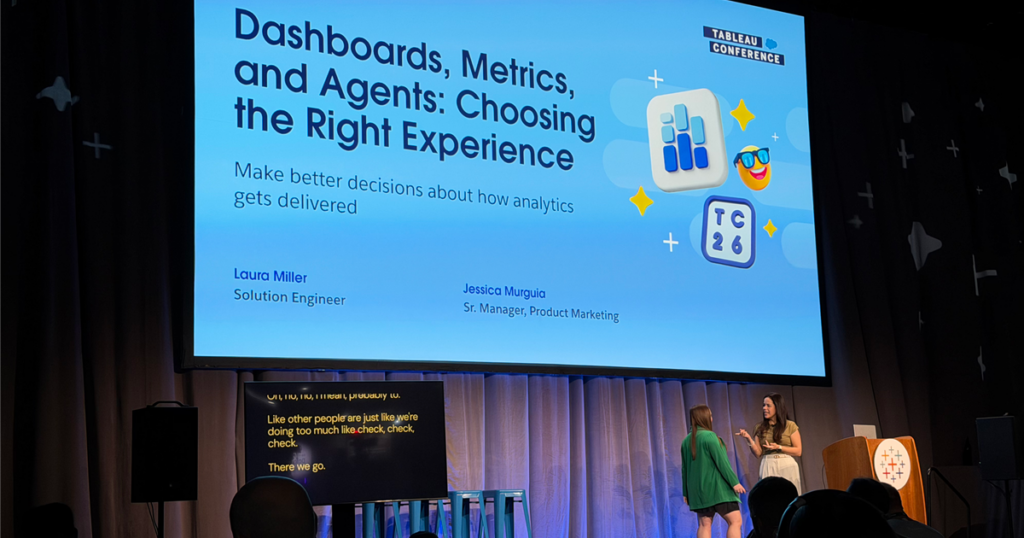
One of the most valuable things we can do for our clients isn’t answer the question in front of them; it’s to know what to ask next. While attending this year’s 2026 Tableau Conference in San Diego, AI was all around us. Right when you walked in almost every booth there had an AI focus or integration. Tableau was guiding everyone by showing how they’ve updated their agentic capabilities from a year ago (yes, only a year) to have more impact in every step of the decision process.
- You can ask the agent why sales were down last month.
- You can ask the agent what is slowing down performance.
- You can teach the bot how to respond to customer questions.
- You can ask the bot to help you build… a bot!
None of this is unexpected. In fact, that was a feeling throughout the conference: there is most likely an AI solution ready or coming for your needs. The question isn’t if AI will change how brands, agencies, and data interact; the question is how AI will change that interaction. These are powerful tools that allow users to find answers more quickly, ask new questions, and get business results faster.
During the keynote, Chad Stroup from Disney was asked two questions that stood out. First, what is something his team wished Tableau could provide to make their jobs better. Second, where did he see his team three years from now with Tableau’s help. The answers were almost identical: first they needed to reduce the distance between the data and the decision on the ground. Bring the product analytics out of the office and into the real world. And second, they expected Tableau to have solved that problem by then. He was expecting to have a new agentic analyst that could help answer “the next question.” Tableau is a great tool to build reports that answer questions. The agents can help answer the questions that are sparked by seeing those reports — the next questions.
What About the Media Industry?
Building quality reports and handling data from all kinds of sources is essential for any AI Agent to have value when answering key questions. The media industry relies on context to help answer questions like:
- Why did performance spike last week and then return to normal?
- What are the top regions that make sense to test a new product in?
- What channel will help us reach our target audience effectively?
Our role throughout the process from planning to buying to reporting is to provide the client with that context. For 40+ years, Harmelin has built an understanding of the context surrounding these questions. We are constantly integrating new data sources and visualization features into reports, so stakeholders get what they need. Now, with the addition of proprietary AI tools and custom reporting, we can reduce time spent getting to an initial insight, answering the first question.
Tableau tells us that agentic AI will inform what comes next. After the data is usable, the report is built to visualize the results, and the analysis is delivered to a client, we need to embrace the follow-up curiosity. AI is not perfect and that was made clear. People who have expertise are critical for guiding users towards meaningful outcomes. If anyone can ask an AI agent about something they see in a report, we need to be ready with context for that answer. Our clients are ready for us to answer that next question.
For a deeper look at Tableau’s specific feature updates from the conference, see Ryan’s post, Tableau Conference 2026 and the Rise of Agentic Analytics.
For more information, visit harmelin.com, or connect with us on LinkedIn or Facebook.