
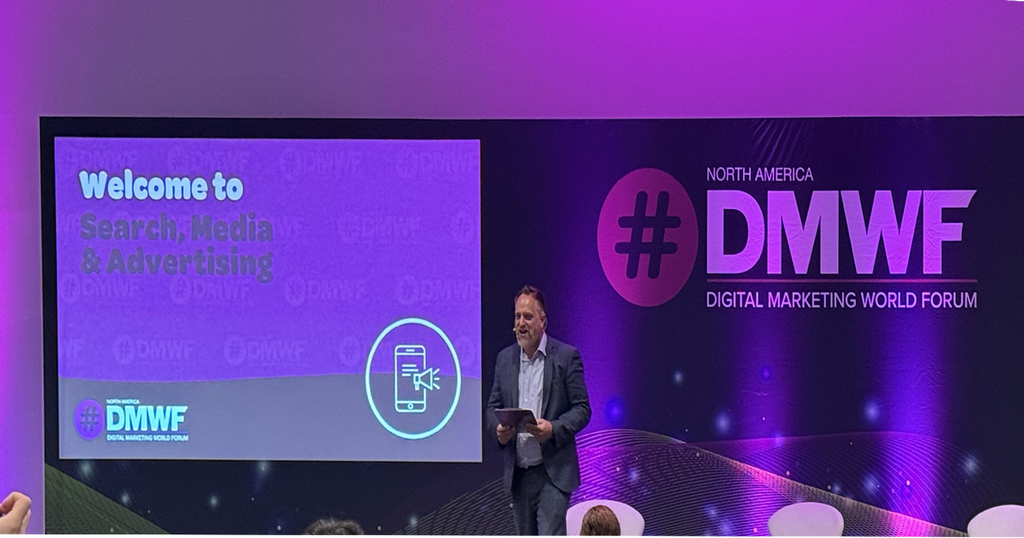
This year’s Digital Marketing World Forum (DMWF) in NYC highlighted how AI is reshaping search, discovery, and performance marketing, while reinforcing the enduring value of trust, creativity, and customer-centric strategy.
The dominant theme across the conference was clear: marketing is entering a new era where success is no longer defined solely by rankings, reach, or automation. Instead, brands must adapt to a landscape driven by AI-powered discovery, predictive audience intelligence, and increasingly fragmented consumer journeys.
One of the most compelling discussions centered on the future of search and brand discovery. During the Search & Discovery Future panel, Jess Barr, VP of Social and Digital at Hunter, challenged attendees to rethink traditional SEO through the lens of what she called “search everywhere optimization.” Rather than relying exclusively on Google rankings, brands must recognize that AI platforms now pull information from social channels, Reddit communities, niche publishers, earned media placements, and brand-owned content. With consumers increasingly relying on AI-generated answers instead of clicking through to websites, visibility is no longer dictated by ranking alone. As Jess noted during the panel, AI is shifting the question from “Did we rank?” to “Were we chosen?”
That shift has major implications for both agencies and brands. Jess pointed out that a brand’s website often accounts for only a small percentage of the sources cited by large language models, highlighting the need for marketers to think beyond traditional SEO tactics. The recommendation was unambiguous: invest in authority signals such as expert commentary, first-party research, schema markup, and strong earned media strategies that help shape how AI systems understand and present your brand.
The discussion on discoverability was complemented by perspectives from Jay Altschuler of Mastercard, who emphasized that trust is becoming one of the most important competitive advantages in an AI-driven environment. He argued that discoverability is increasingly tied to becoming a trusted voice within communities rather than simply occupying the top search position. For brands, this means participating authentically in conversations, delivering value through content and experiences, and maintaining consistency across every consumer touchpoint. His perspective reinforced a recurring conference theme: trust is no longer just a brand attribute; it is a discoverability strategy.
This evolution of search was reinforced during the Customer-First Keywords session, where Michael Louderback of ROAST encouraged marketers to move beyond conventional keyword research and embrace what he described as “demand intelligence.” Rather than focusing exclusively on search volume, he outlined a framework centered on understanding customer motivations, behaviors, questions, and decision-making patterns. By combining keyword data with insights from communities, reviews, forums, and AI-driven prompts, marketers can build richer audience profiles and create content strategies that better align with how people actually seek information today.
Another recurring theme throughout the conference was the growing importance of first-party data. Whether discussing audience intelligence, performance marketing, or AI activation, speakers consistently emphasized that first-party data remains the foundation of effective marketing. However, there was strong consensus that first-party data alone is no longer enough. Brands must enrich, activate, and measure that data effectively if they want to remain competitive.
This became especially evident during the Performance Marketing Now panel. Ryan Berkeley of Bayer Consumer Health discussed how Bayer approaches all media with an accountability mindset, emphasizing the importance of unified measurement rather than relying on individual platform reporting. Speakers repeatedly challenged marketers to look beyond platform-reported ROAS and embrace incrementality testing, marketing mix modeling, multi-touch attribution, and analytics platforms to understand true business impact.
Meanwhile, Martin Corso of Spotify provided a practical example of the power of strong data activation, citing a case where enhanced implementation of Pixel and Conversions API capabilities resulted in a 22% lower CPA. His example served as a reminder that while AI continues to dominate industry conversations, foundational measurement and data infrastructure remain just as critical to performance success.
The conference’s AI-focused discussions tied many of these themes together. During the AI in Media & Audiences session, speakers positioned AI not merely as an automation tool but as a prediction engine capable of identifying audience intent, forecasting behavior, and enabling real-time optimization. The most successful organizations, they argued, will be those that use AI to accelerate decision-making while maintaining strong human oversight. Creative storytelling, transparent measurement, and responsible governance were repeatedly cited as the factors that will separate market leaders from organizations simply adopting the latest technology.
The biggest takeaway from this year’s DMWF is that the future of marketing will belong to organizations that successfully balance technology with human expertise. The tools may be changing rapidly, but as was emphasized throughout the conference, the brands that win will be those that earn trust, understand their audiences, and create value wherever consumers choose to engage.
For more information, visit harmelin.com, or connect with us on LinkedIn or Facebook.